How the Long-Playing Record Shaped Album Listening
See how the long-playing record shaped album listening through side length, track order, and the small rituals that help a sequence feel whole.
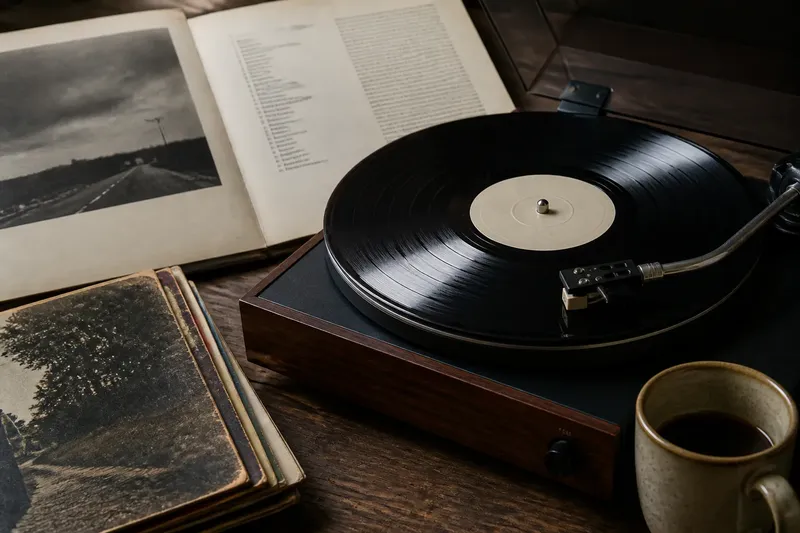
The long-playing record made a group of songs available on one disc side, so listeners could hear a sequence without changing records after each track. Album listening grew from that practical arrangement, though the format did not require anyone to hear every side from beginning to end.
The long-playing record made a side into a listening unit
A long-playing disc held more music than the shorter records commonly used for individual songs. Its grooves formed a continuous spiral, followed by a stylus. Several tracks occupied the same surface, arranged in an order that listeners could follow or interrupt.
A single offered a compact choice: play one song, then put the record away or select another. A long-playing side offered a longer stretch of music within a physical boundary. It was like a chapter in a book: the boundary gave the sequence a shape, but did not dictate how a reader—or listener—should respond.
The sleeve and label could show track titles, but the grooves did not offer a menu. A listener who wanted a particular song might move the tonearm to its starting point. Letting the record run, by contrast, made the printed order the easiest route through the music.
Track order gave neighboring songs a relationship
The opening track was the first sound after the stylus touched down. It might establish a mood, introduce a voice, or begin without ceremony. The next song followed because of its position, not because the listener had to make another selection. That sequence let one track color the way the next was heard.
A quiet song after a forceful one can feel like a release; a brisk track after a slow passage can restore motion. Such contrasts do not turn an album into a story with a plot. They give the listener a way to hear pacing and connection among songs that might also stand alone.
Imagine you put a record on after supper and decide to hear one side in its printed order. The opening song catches your attention, a quieter middle track creates a pause, and the last song leaves a sense of closure. In this invented situation, the sequence feels shaped, even though nothing establishes that the musicians intended a narrative.
A side’s endpoint made a pause part of the experience
The end of a side was physical as well as musical. After the final track, the stylus reached the runout area. The listener could turn the record over, choose another one, or stop. That small decision separated one sequence from whatever came next.
The pause made room to notice what had lingered or where attention had wandered. It also gave the next side a fresh beginning. Not every listener treated the break as meaningful, but the format made it available as a natural point to stop or continue.
Track order is a starting point, not a rule. Some listeners follow a complete side; others replay a favorite song or let a record accompany another activity. Both approaches make sense: one emphasizes relationships between tracks, while the other brings an individual song forward.
What do listeners often ask about album listening?
What made a long-playing record different from a single?
It placed several songs on one disc side, allowing a longer sequence without changing records after each selection. That arrangement made neighboring tracks easy to hear together.
Did every album tell one continuous story?
No. Tracks could connect through contrast, mood, or pacing without presenting a plot. Listeners might also hear the songs as separate pieces.
Why does turning a record over matter?
The pause divides a larger program into sides and gives the listener a choice about continuing. It can make the next sequence feel like a new section rather than an uninterrupted stream.
Can an album still be heard one track at a time?
Yes. Selecting one song changes which relationships are in view, but it does not erase the song’s place in the album. Hearing the full side later can make that context more apparent.
Album listening remains a choice about sequence
The long-playing record offered a tangible route through music: start at the opening, follow the side’s order, then decide what comes next. The format made that way of listening convenient; it did not establish that every listener adopted it or that albums had to be heard as complete works.
To hear the album idea clearly, compare a track on its own with its place among the songs around it. The main phrase, long-playing record album listening, points to that distinction: order can add meaning without taking away a song’s independence. Even after the record stops, the sequence may be what a listener remembers.