Headphones or Speakers for a First Listen?
Headphones or speakers for a first listen? Choose a listening setup that fits your purpose, so you can hear how a recording’s parts work together.
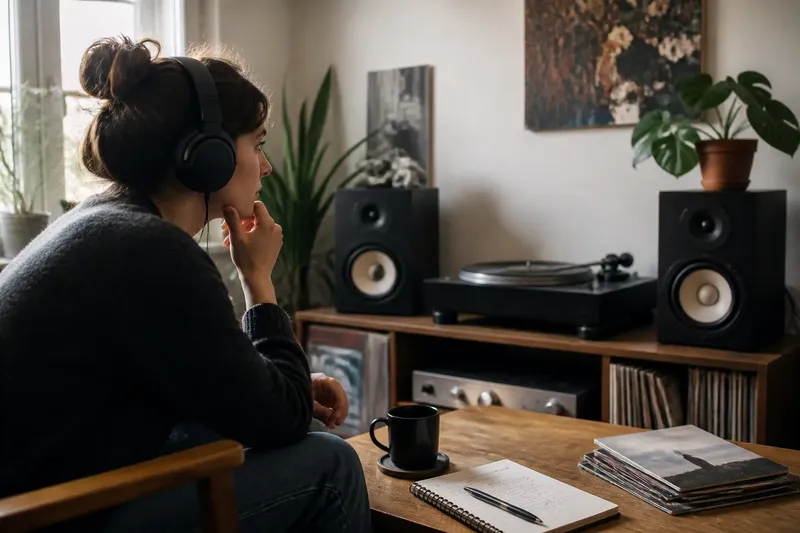
Headphones or speakers for a first listen can shape how you take in a recording’s arrangement. Headphones bring the sound close; speakers let it meet you through the room. Choose based on what you want to understand about the music, not on which format is supposed to sound better.
A first listen does not need to settle whether a mix is good. It can simply give you a sense of the song’s structure, the performance, and the way its parts relate. Start with the format that suits your setting, then switch only if a specific question remains.
Headphones or speakers for a first listen serve different purposes
Headphones keep the left and right channels close to your ears, with little room sound mixed in. That can make stereo placement feel pronounced and bring small performance choices forward, such as a singer’s change in phrasing or the way an instrument enters between vocal lines.
The same closeness can make a recording feel more separated than it does elsewhere. A voice may seem detached from the band, while a reverb effect may sound like a distinct layer. Those impressions describe the headphone presentation; they do not establish how everyone should hear the song.
Speakers send sound through the room, where reflections and the placement of the speakers affect what reaches you. They can make an arrangement feel more like one shared event, with voice, rhythm, and accompaniment occupying the same space. A familiar analogy: headphones are like reading a note under a desk lamp, while speakers are like hearing the message spoken across a room. Each situation shapes your attention without changing the words.
Room layout matters. A speaker near a wall may make low notes feel more prominent, and sitting much closer to one speaker can shift the stereo image. The result is not necessarily a flaw in the recording; it may be a feature of where you are listening.
Listen for how the song unfolds, not for a hidden detail
A first pass is often more useful when you follow the song’s larger movement: where the vocal enters, how the rhythm changes, whether the arrangement opens up, and how the ending resolves. This keeps attention on the music as a whole instead of turning the listen into a search for one faint sound.
Choose headphones if you want to stay with a performance or follow a stereo effect without much room sound. Choose speakers if you want to hear how the full arrangement hangs together in your space. If a part seems absent, consider whether the room is noisy, the listening position is uneven, or the recording simply places that part in the background.
Playback settings can also shape the impression. Equalizer controls, spatial audio, and other processing may differ between a phone, computer, receiver, or music app. If the sound changes more than you expect, check whether a setting is active before drawing conclusions about the mix.
Use a second format only when it clarifies your question
Switching formats can help when you know what you want to compare. Say you hear an invented song on speakers: a singer is accompanied by a hand drum, and the chorus seems to widen. You wonder whether the change comes from added instruments or from the stereo image. You replay the chorus on headphones and listen for new parts entering; if the same parts remain while their placement feels more obvious, the widening may come mainly from the mix’s spatial presentation. Returning to speakers then lets you hear how that impression fits the room-filling arrangement.
Keep the passage and playback level reasonably similar between listens. A louder version can seem more forceful simply because it is louder, which muddies the comparison. Use a comfortable volume and let your ears adjust after changing formats.
- Notice your setting: If conversation or household noise competes with the music, then choose headphones or move to a quieter room; otherwise, use the format that feels comfortable.
- Check your listening position: If you sit much closer to one speaker, then move to a more centered seat; if the image still feels narrow, accept that the recording may use a centered or restrained presentation.
- Check playback processing: If an equalizer or spatial-audio effect is active, then turn it off temporarily for a clearer comparison; if no processing is active, compare the formats without changing other settings.
- Choose the purpose: If you want to follow a performance closely, then start with headphones; if you want to hear how the arrangement fills your space, then start with speakers.
- Keep the comparison fair: If one format is noticeably louder, then lower it to a comfortable, similar level; if the levels already seem close, keep them and focus on the same passage.
- Decide whether to switch: If a specific question remains after the first listen, then try the other format for that passage; if no question remains, stay with the first impression rather than searching for a flaw.
Which format fits your first listen?
Are headphones better for hearing a performance?
They can make it easier to stay with small changes in phrasing because the sound is close and less affected by the room. The recording’s arrangement and your headphone fit still shape what stands out.
Do speakers make a song sound more natural?
Speakers include the listening room in the experience and can make a song feel more outward. “Natural” depends on the room, recording, and what you want to notice.
Why does the same song feel different on headphones and speakers?
The sound reaches you by different paths: headphones sit close to your ears, while speakers interact with room surfaces and listening position. Processing settings can also affect one output differently from another.
Should you listen to an album on both formats?
There is no need to switch unless the other format suits your setting or helps answer a question. One attentive listen is enough to begin hearing how the album’s songs are put together.
Let your listening purpose decide
For headphones or speakers for a first listen, begin with the format that fits your room, your company, and the kind of attention you want to give the music. Headphones offer a close presentation; speakers bring the room into it. Neither is a universal reference for how a song ought to sound.
That simple choice can keep a first listen relaxed and useful. Listen for the song’s movement before judging its details, and change formats only when the change helps you understand something specific about the recording.